Sunday, February 26, 2006

Reading for understanding

I need to update my reading list on the right; my parents brought over some books I'd ordered and I've been dipping into them when I have the time. I'm still on a Eugene Peterson kick, just finishing his book on Jeremiah, Run with the Horses, where he writes:
Any part of our lives that is turned over to the crowd makes it and us worse. The larger the crowd, the smaller our lives.... On the other hand, every time that we retrieve a part of our life from the crowd and respond to God's call to us, we are that much more ourselves, more human. Every time we reject the habits of the crowd and practice the disciplines of faith, we become a little more alive.
This is how I felt about our two years of homeschooling, as well as our time here. I prefer living out of the mainstream, although not to an extreme – we're not to isolate ourselves from the world, only live differently in it. And you can't help but do so here.

A friend lent me G.K. Chesterton's Complete Father Brown, which I've just started. I used to read mysteries more often; in fact, Lord Peter Wimsey led me to Dorothy L. Sayers' other works on classical education and apologetics, which I love. (I have to admit, though, that I first discovered Wimsey on Mystery! rebroadcasts before I picked up the books. Thanks, Mobil.)

I bought my dad a copy of Taiwan: A Political History by Denny Roy, and he very kindly left it for us to read after they flew home. I have picked it up and read some random passages, but really ought to read it all the way through. I'm sure I'd understand the current events much better if I had a grasp on the historical ones.

My other reading is mostly along the lines of Where's Spot? and Peekaboo Bunny, which I enjoy for the company that my reading aloud brings me. Books are good companions, but even better when shared.

Friday, February 24, 2006

All there is to see

Hey, I just wanted to mention that in the post below I've hyper-linked some words to their related photos in Formosa Fix (my photo gallery). In the process of setting all that up I discovered that you can click on any photo to enlarge it -- you'll get much more detail that way. The whale shark is a bit more impressive viewed full-size.

Enjoy!

Thursday, February 23, 2006

The grand tour

My parents left last Friday, after a two-week, too-short visit. We managed to see quite a bit of southern Taiwan while they were here, but I wish we'd had a bit more time together. That's my perspective, though, as one who knows all the places I'd wanted to take them and how many we didn't get to. I hope that in their opinion we did enough... but not too much. I know they were most eager to spend time with the grandkids; traveling was secondary. We were blessed with warm and mostly clear days while they were here. One of our first outings was to the 85-story Tuntex tower. On the right, here, is Nora taking her turn on the coin-op binoculars. She got a really good view of everyone on the observation deck – that's Kaohsiung harbor in the background – and everyone got a good look at her (and more than a few pictures).

After our trip up the tallest building in the city (in one of the fastest elevators in the world), we headed to Costco. This is more of a cultural experience than you might imagine: Chinese Costco is recognizably Costco, but the roasted chickens with their heads and feet intact, the nearly empty carts at the check-out line (for whatever gets bought has to get home, and many shoppers come on scooters), and gray-robed Buddhist nuns poring over their receipts all give you the sense that you're not in Kirkland anymore.

Shopping falls somewhere between sport and chore in Taiwan. My mom and I found a few treasures at Dollars and Walason's, but the outings took a lot of effort. Much more relaxing was our weekend in Kenting (pronounced "kun-ding"). The weather was warm and dry, traffic was light, and the drive was pleasant: we passed betel nut plantations, old women selling wax apples and yellow onions at roadside stands, men standing over barbecues of skewered squid. (On the way home we bought some fruit and a bag of onions, but skipped the squid – the eyes turn me off.)

One of the highlights of the trip was the National Aquarium. This is a world-class facility, with walk-through tanks of tropical fish and coral, a pool of beluga whales, and a giant wall of glass holding back schools of tuna, gliding skates, and a pack of menacing whale sharks. We spent a morning at the fortified lighthouse on the very southern point of the island, Oluan Pi ("o-lun be"). Vendors lined the park paths, selling shells, toys, and coral jewelry. We drank sweet cold coconut juice right out of the shell, and got the soft white meat scooped out for us when we were done. We ended our day at White Sand beach, where it was still warm enough for Cole to chase some waves. Kenting is close enough to be a day-trip; we should go more often.

The second week of my parents' visit went quickly: we shopped, visited Cheng Ching Lake, and went up into the hills to an aboriginal culture village. Mom and I helped Cole's class celebrate Valentine's Day, and my dad spoke to some students about drumming: the history, the discipline, and the joy of playing well. He is a born teacher. We were so happy to have them here. Kaohsiung is no paradise, but there's more here than just the city. I hope they enjoyed themselves, and I really hope they'll come again.

Saturday, February 11, 2006

Taking a break

My parents arrived safely last Friday, whereupon we all got sick to varying degrees. Not the best start to a vacation, but with mom and dad sleeping off jet lag anyway maybe it's not so bad, timing-wise. It's great to have family here – it feels more like home now – and hopefully it helps them understand our life here a little better.

We're off to Kenting for the weekend, so I'll be incommunicado for another few days. I'll get some pix of the sun and sand for you next week. Till then....

Thursday, February 02, 2006

Happy New Year (please pass me a tissue)

Well, it's official: the Year of the Dog has commenced. Cole and Nora both have a fever and cough, and my nose is driving me nuts, but hey, we're on vacation, the weather's been great – it could be worse.

We only had a smattering of fireworks in our village this year, but an unbelievable amount of traffic. The holiday follows a strict heirarchy of family visits – driving on New Year's eve to spend New Year's day with the husband's family, then driving, sometimes across the country, to spend the next couple days with the in-laws (the husband's in-laws, that is – the Chinese always lose a daughter, never gain a son). The flow of people has been uneven, with one side of the freeway crawling along while the other direction is wide open; when we've had to go out, we use surface streets and avoid the worst intersections. I don't think people here are big on shortcuts. Everyone seems to stay on the main roads, even when everyone, literally, is on the road. Most foreigners stay home over the holiday; it's not a good time to go sight-seeing.

Last Saturday we did venture out with our friends, the Pinkertons, to the New Year's market. (I took tons of photos, but have had difficulty loading them – check the photos link in a day or two.) The market is open all year as the dry market – dried mushrooms, beans, fish, tea, assorted grasses and grains, powdered who-knows-what – but I haven't gone before, so I don't know what distinguishes it as the New Year's market right now. There were stalls selling red banners, tassles, envelopes, and so on, and a man creating large calligraphy banners, but otherwise it seemed to be a pretty normal dry market. Just very, very crowded.

My parents will be here in two (two!) days, so I'm going to keep this short and get back to my to-do list. Our study is slowly being transformed into a guest room, thanks to Tim. The rest of the house needs a little attention, though, so off I go. My dirty windows beckon.

Wednesday, January 25, 2006

Earth & Altar

Wow. What an amazing book; very challenging. I finished reading it tonight as I sipped a hot chocolate at Starbucks all by myself, which is worth italicizing. I really like Eugene Peterson, and would like to buy about a half dozen more of his titles. Maybe I can get my parents to bring them when they come.

Earth & Altar covers eleven Psalms and shows how praying them will help release us from the self-centeredness that not only stunts our own growth but damages society as well. Lots of good stuff, but the last chapter was particularly relevant. Here's a bit of it, as Peterson delves into Ps. 45, a wedding song. He is describing the bride, a princess marrying a king in another land:
She is in a strange country. She is in unfamiliar territory, addressed in strangely accented speech, away from the cozy securities of friends and family. She is full of longings for what she has left. As long as she is attached to her childhood and her family and her customs (that is, the things that certified her acceptance and significance), she is incapable of a new venture in love.
He goes on to say:
Love launches us into new territory. To explore the new, the old must be left. It means leaving earlier levels of accomplishment and relationship and growing into new ones. Every act of love is a risk of the self. There are no guarantees in love. Much can go wrong: we can get hurt; we can be rejected; we can be deceived. But without risking these perils there can only be a repetition of old patterns, the routinization of old comforts.
And then he addresses the self:
The self cannot be itself if it does not grow, and for a creature made in the image of God to grow is to love. No living being can be static.... Self love is obsessed with keeping what it has and adding a little more of the same. That is why it is so boring. There is never anything new to say, nothing new to discover. Self-love assesses its position by what is has and is panicked at the thought of losing any of it. Forced into new relationships, into new situations, its first consideration is not of the new fields for love but of the appalling prospects of loss. So it clings. It holds. And it whines.
This has been my struggle over the last five years, knowing that great possibilities lie before me if I will only let go of the familiar. Easier said than done, although I'd like to think I've made some progress.

The book has been republished under the title, "Where Your Treasure Is." I recommend it highly.

Across the wall

This is a picture I snapped last week of the old woman who lives next door. She and her son were walking around the dirt lot that used to be her husband's guava orchard (before it became a giant rock-sifting facility and place where trees come to die). The house is quiet now, so I think she may have moved in with one of her children. One of her sons comes by a few times a week to help pick guava, but other than that it's feeling pretty deserted.

I hope I'm not coming across as some kind of stalker here. This has been a fairly public episode of their lives, and I have been intrigued, eager to glean what I can from it. How we handle death reveals so much about our culture as well as who we are as individuals. I find it fascinating.

Pineapple fields forever...

I will show great restraint and not use any more Beatles allusions. (You're welcome to hum along in your own head, though.)

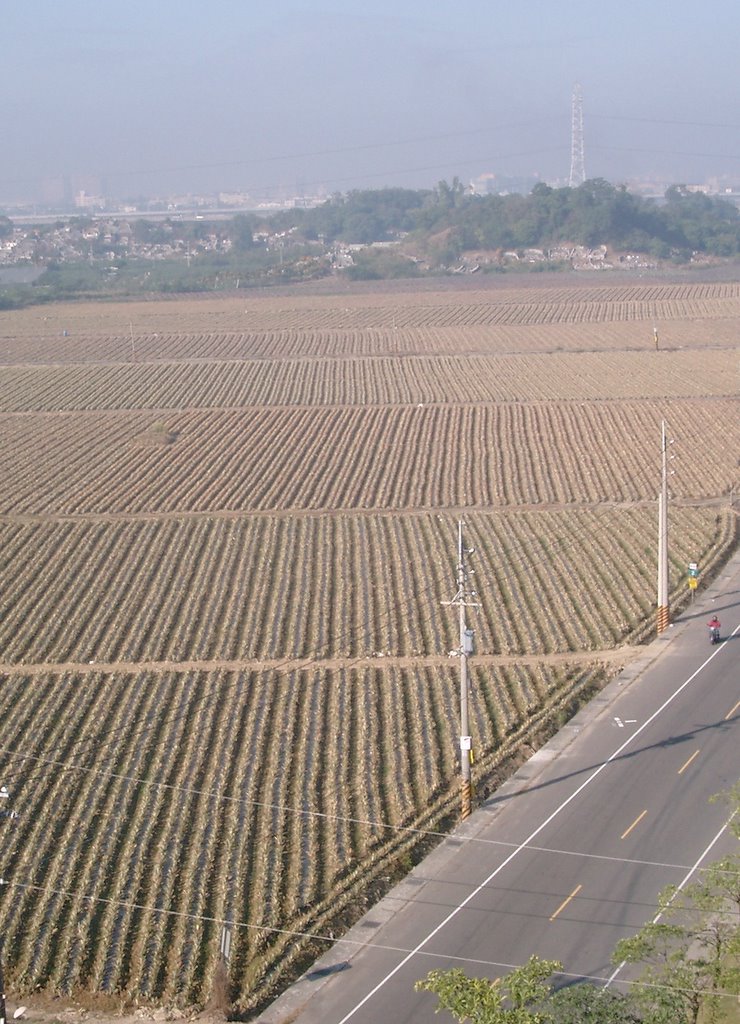
This is a view of the pineapples, taken from our roof eight floors up. Not a great shot, but I did say I'd post one, so here it is. I'd like to get some close-ups of the women who work in the fields, but I'm too shy. It would require me to go walking through the rows, uninvited, and then stand there with camera in hand, butchering the little Mandarin I know as I try to explain my intentions – either that, or just boldly start taking pictures. Neither option appeals. I need to get over myself or get a better camera.

I did try to photograph the women last fall. They were working near our school and would take their midday break in the shade of the trees near our gate. Nora and I would deliver lunch to Tim and Cole, and the ladies, crouched over their noodles and tea, would smile and pat Nora's arm as we went by. After lunch, though, on our return home, we'd find the whole group of them sacked out on the sidewalk (never the grass, perhaps because of the spiders, whose little wispy webs dot the lawn in the mornings). Lying on their sides, the women would pull their coats over their heads and just check out for an hour or so. Shou syi, I think it's called – like siesta. A few times I had my camera ready, so I could snap a shot as we passed, but someone would always raise her head as I came near, and I would chicken out. Maybe that's for the best. It doesn't seem right to treat your neighbors as anthropological subjects, even though on one level that is what they are. It's the other, deeper level of our shared humanity that stops me. I wouldn't want someone to be so brazen in their curiosity of how I live. Well, come to think of it, people here are brazen in their curiosity of how I live. But I don't particularly like it, so I try not to do the same to them.

Saturday, January 21, 2006

Thoughts on Geisha

I finished Memoirs of a Geisha the other night. Quite a good read. I hear the movie is well done, too; maybe Tim and I can see it next week. I like Taiwan; I like Chinese people and their culture – but I have to say that they've got nothing on Japan when it comes to raising everyday life to an art form. I used to lump the two cultures together as being artistically sensitive, and while the Chinese have produced amazing art over the centuries, the appreciation of beauty has not been incorporated into the common life here as much as it has in Japan.

The Japanese occupied Taiwan for fifty years (1895-1945). There is still evidence of that in the architecture, the language, even the faces of people, particularly here in the south of the island. The Japanese started the first schools for the deaf in Taiwan, and the local sign language still bears the mark (like Laurent Clerc's French influence on American Sign Language, albeit under very different circumstances). My impression is that most young people here hold a positive opinion of Japan. I came across this article, however, that outlines mainland China's position (and political strategy) that she and Taiwan are united against a common foe: Japan. I don't imagine that this will be very effective, especially with the younger generation here not only lacking the first-hand experience of living under Japanese occupation, but in general wanting to be much more like Japan.

So, any suggestions on what I should read next?

Winter's chill

Oh, wait, that's just the A/C.

Yes, the air-con is on again - just for a few hours last night, and just in the dining room, but this might be the beginning of summer. Our west-facing bedroom wall was warm to the touch (after two months of being cool and clammy). Once it starts giving off heat then the bedroom A/C will be called into play, too. Lots of fog these last few mornings, which I think means the temperature's making a big jump in the mornings. The humidity is up, as well.

I just added a weather sticker to my sidebar so you can check all this youself, if you're so inclined.

Not much news, otherwise. Tim is headed up to Taipei to photograph a basketball tournament this weekend. While he's gone I'm going to try to get our guest room into shape - my parents are coming in about two weeks. (Yay!) And maybe I can catch a game tonight with the guys – Citadel or Puerto Rico or Settlers. This is quite a partying group of missionaries here. No joke.

Well, Nora is patiently sitting at my feet, waiting to go out and swing, so I better scoot. More soon.

Tuesday, January 17, 2006

Aren't we forgetting someone?

This doesn't have anything to do with Taiwan, but when I read this story from The Observer, I recognized this man immediately as a fellow third-born:
A British man kidnapped in Iraq and held for five days by armed men who threatened to behead him was rescued last week by American special forces and astonished to discover that no one had noticed he was missing.

I feel for him, man.

What I know is...

We had an earthquake last week – not big, but enough to get my attention as I was drifting off to sleep. I mention it because I had been expecting an earthquake for several days prior. It's nothing more than being in tune with the cycles of things – I'm not claiming any special power here – but we seemed due for one, and then there it was. (This happened before the quake in November, too.) I'm not all that fond of earthquakes, but there is some comfort in knowing a place so well.

I've been thinking of the other peculiar ways I know Taiwan. My butter and salt tell me the weather (butter stays hard on cold days, and my dish of sea salt clumps up in the humidity, even when there's no discernible change inside the house). I know what color the sky turns before a big storm, although I am still caught off guard when we have rainy days in the dry season. I heard shooshing in the street this morning and thought, "What is that?" Thirty-some years in Washington should have taught me by now.

I know what other drivers are thinking, or at least I can predict the moves they're going to make. (Whether there's a thought process behind the action is sometimes debatable.) I enjoy the organic nature of driving here, like water seeking the most natural course. It's best not to fight it.

I know when people are surreptitiously photographing my children at Costco, and I can spot fellow foreigners by the way they move (as well as by the content of their carts).

I can identify almost all of the kids in our building by their various cries.

I know that congealed chicken blood tastes lovely until you know what it is.

I know how to say what I want at McDondald's, but I also know that the order will not be right.

I know that my Chinese teacher will utter the words, "What I know is..." at least once in every conversation. It always makes me smile.

I know which parking garages can accommodate our very tall Toyota Zace, including the ones that say they're too low but really aren't.

I know how coin-op grocery carts work.

I know how to use chopsticks, and how not to use them, which is just as important.

I know that I may pick my nose in public (although I don't), but never my teeth (which I sometimes do). I know I use more paper napkins when I eat beef noodles then anyone else around me. I don't know how they do it.

I know my European shoe size, my children's heights in centimeters, and what to wear when it's 16º, 21º, or 34ºC.

I know what it's like to be almost famous. We are stared at, approached, photographed, and whispered about wherever we go. Sometimes it's flattering, and sometimes just annoying.

I know there's a reason we're here, and I know there will come a time to leave. I don't know the details on either count, but God does, and that is good enough for now.

I know the next few years are going to be interesting.

Sunday, January 15, 2006

Next!

Time for a babysitting update:

Su Ruong did not, in fact, come back, but she very kindly found us a replacement. Sandy was able to come for about a month, until her nursing intership began in December. (We had fewer tears with Sandy.) She, in turn, introduced us to Rebecca, who was with us for a few weeks (she is also a nursing student), and who sometimes brought her friend Twiggy along. When Rebecca's time was up she found us Star. I understand that Star is available for two weeks, including her first visit this past Thursday. No other prospects on the horizon, so Nora may be tagging along to Bible study for a while. She behaves well, but I would prefer to go alone and not have to divide my attention.

The one good thing to come out of the whirlwind of sitters is that Nora barely makes a peep when I step out the door now. She's also good with names. When Star left last week I prompted Nora, "Say goodbye!" And she complied: "Goodbye, Star. Goodbye, Rebecca. Goodbye, Sandy. Goodbye, Twiggy. Goodbye! See you next time! Dzai Jien!"

I'll have to teach her to say "Next!" in Chinese.

Thursday, January 12, 2006

Resolve

More exercise is on my horizon. Not as a New Year's resolution (my last one was circa 1989: "No more resolutions"), but as an avoidance technique. I bought a new pair of Levi's last week at Costco. No fitting room, of course, so I bought a size that resembles my impression of myself and took them home. I find that I can get all five buttons done, but another inch in the waist would have been nice. However, making a return is about as appealing as gum surgery, so I'll hit the treadmill instead. I have no gripe with my bathroom scale (don't worry, Mom!), but it would help to get a bit firmer in places.

I don't usually buy clothes at Costco - or anywhere in Taiwan - but my favorite jeans have reached a critical stage of fragmentation. A spot below the right rear pocket is going threadbare, to the point that I've been using duct tape to keep the weft in place. I tape it on the inside, which actually works pretty well. (I dropped this bit of information into conversation the other night when I was compared to Dennis the Menace's mother - you know, the perfectly polished appearance belying the fact that she's about to pull her hair out. I think my tailoring technique put a damper on that idea.)

Despite my long-standing no-resolutions resolution, I feel an urge this year to make changes: more discipline, more writing, more stretching, and stretching my boundaries, particularly regarding speaking Chinese. (Some people live in Taiwan for years and years yet speak very little of the language; I understand why it happens, but I don't want it to happen to me.) My first priority, though, is to get into a better devotion habit. I've been reading a lot of Bible-related texts lately, but if I'm going to get anything out of them I have got to spend more time in quiet meditation. Our women's Bible study is beginning a new book on prayer, so I'm hopeful that it will get me moving in the right direction.

Chinese New Year is right around the corner. I don't know if there is a resolution aspect to it; I know it's a time to be with family and to clean the house. Old debts must be paid (which leads to an increase in property theft this time of year), and red envelopes full of cash are handed out quite generously to the children. In our village it's a week of drinking and fireworks, each for casting out various demons. This will be the Year of the Dog, which happens to be my year (so for those of you who don't know how old I am, I have narrowed it down to a multiple of 12). This supposedly makes me loyal, which is not a bad attribute. I'm not a dog person, though, in general. I hope they don't kick me out of the club.

I feel like we're in a lull at the moment, with the Western holidays just behind us and the Chinese holidays over the next hill. It's good to have a breather. My parents are coming in a few weeks, which we're all very excited about. But for now I feel a bit empty, with not a lot to say (she says, 500 words later). The pineapple fields have been lovely these recent mornings, mellow browns and greens with a bit of gloss to them. I've been meaning to get a picture from the roof so you can see the patterns in them. That's a theme I've wanted to pursue, photographically: order in chaos, the places where the human hand has brought a bit of control to an otherwise unruly landscape. I think I'll work on that for next time. Stay tuned.

Tuesday, December 27, 2005

Ashes and dust

I believe the old man next door has died.

I never met him – I have only ever been an observer of his family's life, and even then only the parts that can be seen from my window – but still, the fractious relationship he had with his land revealed a bit of him to me, and I feel like a knew him a little. He was stubborn, but kind, too. I have a vivid memory from when we lived here before, of him and his grandson walking down the gravel lane, holding hands as the afternoon light, warm and yellow, tinted the dust kicked up behind them. I find myself moved by his passing. It's a reminder of the unavoidability of death, of course, and I also find myself wondering what will happen to his widow and their little farm.

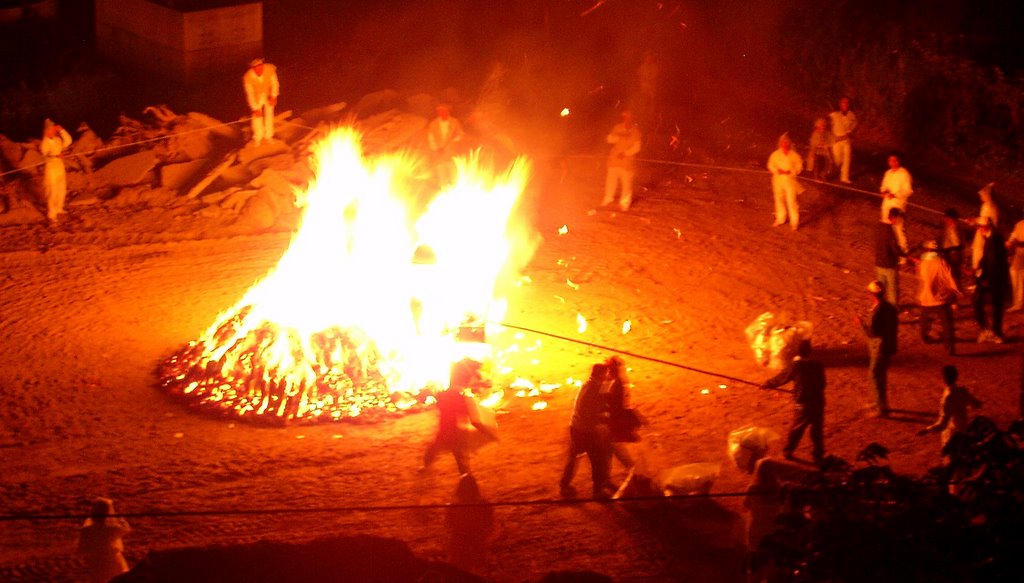
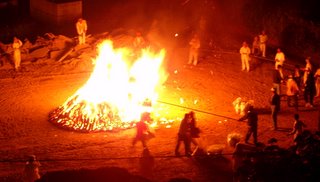
The funeral began in the afternoon of the first Monday of December. I took notice of it not from my window, but from the playground, when I looked up and saw several people in our building leaning on their balcony rails, cameras in hand. I could hear something going on next door, but the wall that separates us is high, without windows, so I had to dash up to the fourth floor to see what was going on. In the clearing stood white bundles of ghost money, carefully arranged to form what looked like a two-layer cake, festooned with flowery tufts of golden paper - more ghost money - shoved into the crevices. Family members dressed in white with sackcloth smocks (yellow for women, beige for men) walked around the pile, wailing. A paper palace stood nearby. Four men picked up a sedan chair and began circling the pile of money while another man set it all ablaze. The mourners stood in a ring around the clearing, each one holding tight to a thin white rope. As the sedan was carried about, the seat began to shake - a sign that the spirit of the deceased had taken his place in it.

This went on for hours: the men carrying the sedan, which rattled quite violently at times; the family encircling the massive fire; and continued offerings of ghost money, even the palace itself, being tossed into the flames. A second team of strong men took over the chair at one point, while a single drummer beat out a continuous tattoo. The skies grew dark, but the fire threw a great deal of light on the scene, and I spent most of my evening watching the events below. The chair was sometimes carried to a spot just out of sight, to a display of what I believe was more spirit wealth, perhaps offerings made by the family, and then carried and tipped towards the fire. It appeared that the bearers were trying to convince the deceased that he would be well-provided for in the next life. He was not in any hurry to go, though; it was quite late when the chair made its final, driving rhythm towards the flames and then fell silent. The remaining money was then heaped on the fire - great bags of it - before the mourners left their positions and walked to the funeral tent across the street.
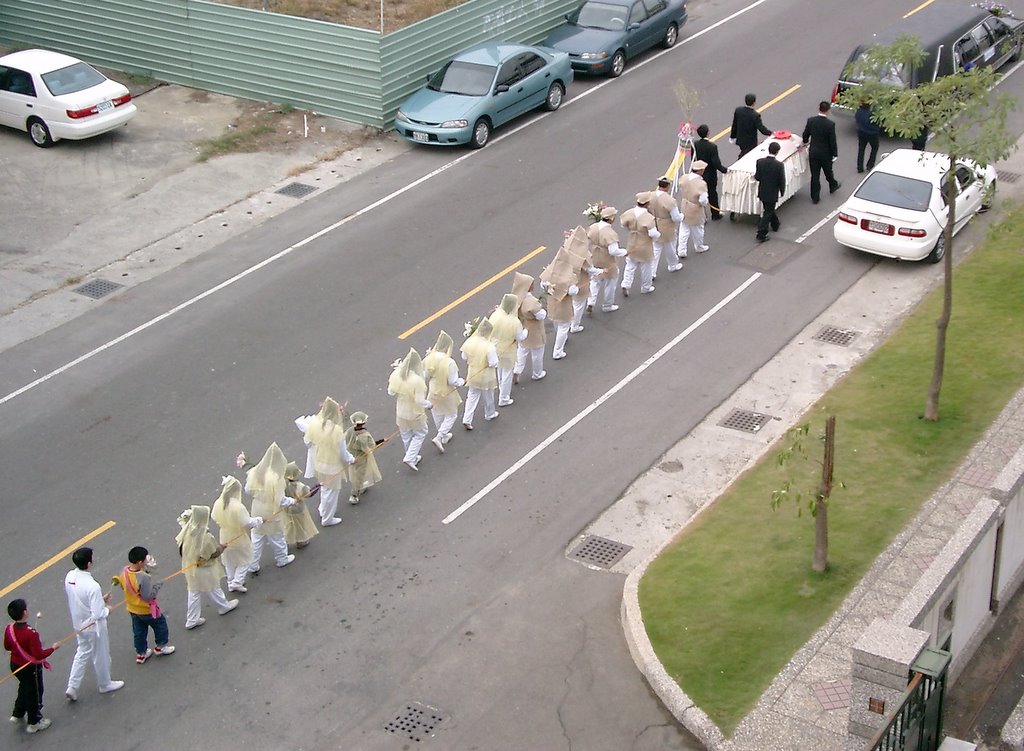
The funeral wasn't over yet, though. The next morning the same party of mourners, holding onto the same white rope, lined up behind the coffin as it was rolled down our street. A hearse led the procession, but I don't believe it was used to carry the coffin at any time. There are many graves in our village, so I expect the old man's final resting place was not too far from home. Music blared from a speaker as they made their way, but otherwise the group was quiet. It would be traditional for the mourning family to come home along a different route, to confuse any spirits who might want to follow them back, and indeed I didn't notice their return. I heard them, though, a short while later back at the funeral tent - short speeches, some more crying. Large wreaths lined the street around the house, and several Buddhist monks were lighting incense and burning brightly-colored papers.

I have read up on some of the funeral practices of Taiwan since then, although not everything I saw has been explained; even so, I certainly understand the motives, the universal desire to honor a loved one and say goodbye with a great showing of respect. Many of the traditions are based on fear, though - fear of the spirit world, of ghosts not properly appeased, of family not provided for in the afterlife. This is a challenge for those Chinese and Taiwanese who become Christians: showing proper respect without bowing to the deceased as an idol to be worshipped. I am glad for my faith, that I can look at death not as a fearful thing but as the moment of transformation from a temporal existence to an everlasting one, and as a moment of reunion. If I fear anything it is loneliness, but not death. I think my ride in the spirit chair would be shorter than a single shake.

The next day the backhoe came and wiped out the circle of ash that remained from the fire. Someone has been hard at work, planting trees in the lot and sifting through the mounds of dirt. I don't know for sure what will become of the farm, but the old woman is still picking her guava, and her son drives it to the market. That is the proof, I guess, that their lives are carrying on.

Monday, December 19, 2005

Edge of the earth

No, I haven't fallen off of it, just dangled there for a while.

The first two weeks of December I battled laryngitis, mostly unsuccessfully, and still have a bit of a cough. Nothing like a lingering illness to take the wind out of your literary sails. But I am working on an entry now, and hope to have it up in a day or two.

Christmas is less than a week away. (You probably know that better than I.) I do not miss the frenzy of the season, but I do miss family and familiar foods. Still, we've got a tree up, vacation has begun, and we are looking forward to a sane amount of socializing in the next couple weeks. It's not a bad way to end the year.

More soon.

Friday, November 25, 2005

Happy Thanksgiving!

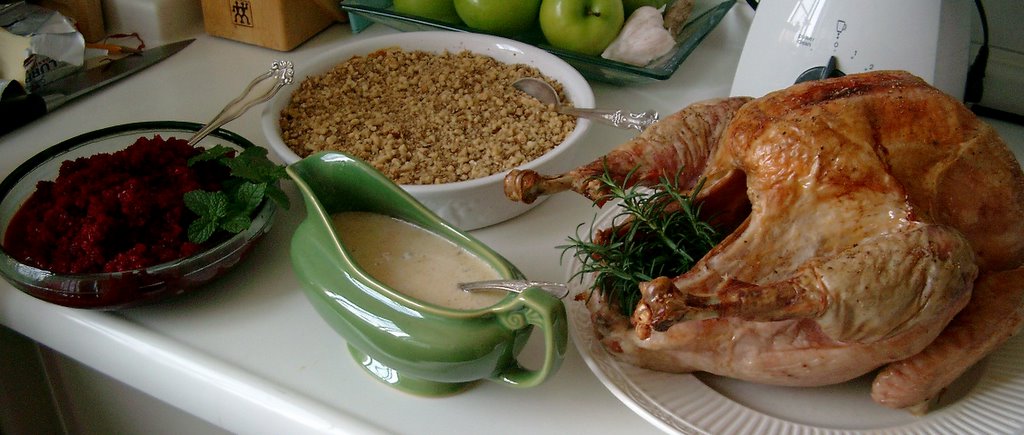
We have so much to be thankful for! God continues to bless us abundantly. We are grateful for our family, our health, Tim's job, a nice home, the ability to travel and explore new places, and so much more. It's good to pause and give thanks for all those things we take for granted all year long. The holidays are a hard time to be so far from home, but we keep up our traditions and are grateful for the company of friends. May you, too, be among friends and loved ones this Thanksgiving. Peace to you all!

Wednesday, November 23, 2005

Rails & trails

We had a great weekend, but boy are my legs sore. A few weeks ago we bumped into a family whose son had attended kindergarten with Cole – the two of them had been great buddies – and they invited us to join them for a hike. So last Friday night we stayed at their house in Chiayi (our first overnighter with a Chinese family), where they treated us to Pizza Hut and Pepsi followed by a tour of the local night market. We hardly ever do the night markets, but this one I really enjoyed: lots of food (like the candied strawberries you see here), people-watching, people watching us – all under a cool, starry sky. It was my first visit to Chiayi, a small city, very clean and inviting. We had a lovely evening.


The next morning after a cold-pizza breakfast we headed for Alishan. With so many little ones along we opted not to hike up, but instead took the narrow gauge railroad (one of only two in the world) to a village in the bamboo forest. The train was crowded, standing room only, but I was immediately offered a seat since I had Nora in my arms. It was an hour to the village, so that was a real blessing. We had an amazing view; the train circled around and through the mountain several times (Cole counted 14 tunnels) before letting us off at 1,400 meters. The air was fresh and cool – such a nice change from Kaohsiung.

We made our way from the station to a nearby restaurant. The owner stood at the door, waving and beckoning people in, while at his side stood a life-sized cardboard cut-out of himself, doing the same thing. Apparently he's a local celebrity; his picture was everywhere. We ate a traditional Chinese meal, what westerners call a lunch-box: a lidded tin bowl filled with rice and topped with cabbage, pickled bamboo, green vegetables, a drumstick, a pork chop, fried tofu, and a curly red garnish that no one could identify. I shared my lunch with Nora, who was most fond of the rice and chicken. I made short work of the rest, except for the Maraschino parsley.

After clearing our table, we walked through the market for some shopping and sweets. I decided against the glow-in-the-dark Alishan Train t-shirts (even though Christmas is coming), but was more than happy to spend 50NT on a bag of peppery ginger candy. Cole bought a dozen glutenous strawberry rice balls, and Nora got a pack of melon gum from 7-11. (Tim, I think, was holding out for a latté.) Snacks in hand, we headed for the trails.

Hiking in Taiwan is not an Eddie Bauer affair. Women in skirts, fur-trimmed jackets and low heels were handling the groomed trails just as well, if not better, than I was in my all-terrain runners. The fact that Nora preferred my arms to the carrier on Tim's back may have had something to do with my lumbering pace – that, and the altitude. But the scenery was worth the effort. A bamboo forest is very calming, so when we came upon some benches I was happy to sit and take it all in. The light filtering through the giant grass was soft and cool. There was very little noise. My first impression was of the uniformity of the forest, endless stick-straight stalks of green. But then I saw shades of brown and grey, even blue mixed in. And as I looked closer I noticed characters – Chinese names, love poems – etched into some of the stems. I wondered who had carved them, and when. The forest had become personal, the sameness replaced with individuality. It's akin to what happens when you live in Taiwan for a while: what at first seems like a massive, homogenous population slowly takes shape as a collection of individuals. Of course that's what they've always been, but it takes some time to see it. Humanity is in the details.

Monday, November 21, 2005

Dishing dirt

We live in the very same apartment now that we lived in during our first two years at this school. It was a strange feeling, walking back through our door after two years away. The apartment looked just as we'd left it; we even found some things tucked away for us (a phone, the Swiffer, a laundry basket) that had been ours to begin with. And outside the house things are much unchanged: the smells, the sounds, the view. Apparently, you can go home again.

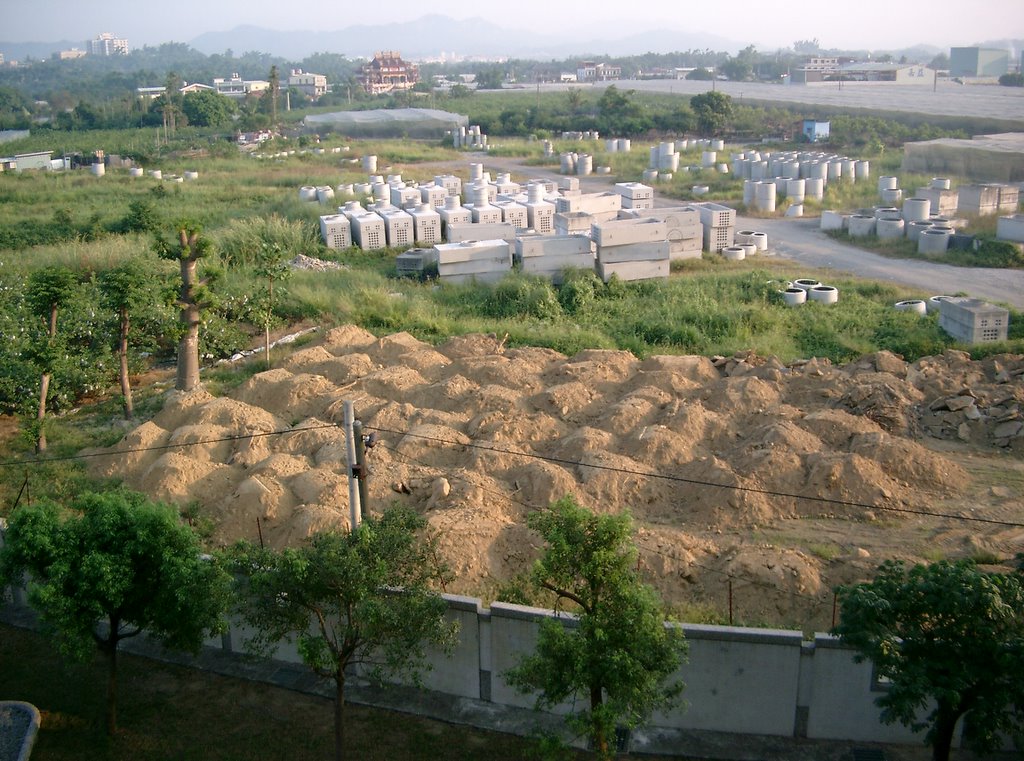
There was some turnover within staff housing, but our neighbors to the north, an older Taiwanese couple, are still here. We've always enjoyed watching them work the land around their house – when we first arrived they planted two adjacent guava orchards, and while the wife could be seen tending to hers without much ado, the husband was constantly messing around, digging trenches only to fill them in again, laying irrigation pipes, pulling trees out for no apparent reason – except perhaps as an exercise in small equipment operations. He loved to bring in the Caterpiller and the backhoe. It was no surprise, really, that she seemed to harvest a lot more guava than he did, but he was probably having more fun.

So we were amused, about a month after our return, to see the same backhoe ripping out all the trees on the old man's side. We waited to see what he would try next. Pineapples are all the rage now, having replaced most of the guava and papaya orchards around us. He really pulled out all the stops, though, bringing in a digger, a giant crane, and a long flatbed truck with four mature trees strapped to its back. Nora and I stood on the balcony and watched as they moved the trees into place – it was quite a show. The trees were stripped of nearly all their foliage, and the roots were cut quite short; I was doubtful they would survive, especially considering they weren't watered at all. They seem to have taken to their new home, however, and stand like crowded sentries at one end of his field.

I knew there had to me more. The rest of his land, bare and dry, was just crying out for something to fill it up. About two weeks ago our patience was rewarded: more dirt. As the first few dump trucks tipped their loads, I thought is was the saddest looking topsoil ever. Whatever he planted would have to be as hardy as his trees. But the trucks continued to come all day long, and the next day, and the next. In the end, he had nearly 60 full loads of dirt brought in – and when the trucks were done for the day there was the backhoe, picking out the biggest stumps and chunks of concrete.

Last week the mystery was solved when an extra long dump truck came and took a dozen piles away: the farmer has turned his land into a fill-dirt depository. Like the huge cisterns in the field beyond, his dirt piles are providing an income that is probably greater than what he could earn with an orchard, with less effort on his part. His wife continues to care for her guava trees, carefully wrapping baggies around the tender young fruit and harvesting them later, still wrapped in plastic, to sell at the morning market. Kaohsiung county is growing, but the land to the west is so fully industrialized that it's the farm land around us that is feeling the pinch. This couple's farm is just the greater transition writ small. They are having it both ways for now, guavas and fill dirt living side by side; we'll have to wait and see how things turn out for them and the surrounding community.

Rain?!

The weather forecast was for clear skies and 77º today and tomorrow, with a chance of rain on Tuesday. A peek out the window, however, reveals that the shushing sound I hear is indeed tires on wet pavement. It's raining! Very strange for this late in the year. It's cool, too – I'm going to go put on a sweater and then post my dirt blog.